The first American service members to die in the were killed in an apparent Iranian drone attack on a makeshift office space in Kuwait, three U.S. military officials with direct knowledge of Iran's attack told TheNews.
At least six Americans were in a strike on a tactical operations center at the Shuaiba port in Kuwait, one of several U.S.-allied countries in the Persian Gulf region that have faced intense Iranian missile and drone attacks since the U.S. and Israel began striking Iran early Saturday. U.S. Central Command has publicly confirmed the deaths.
The on Tuesday. The names of the two others were being withheld until next of kin are notified.
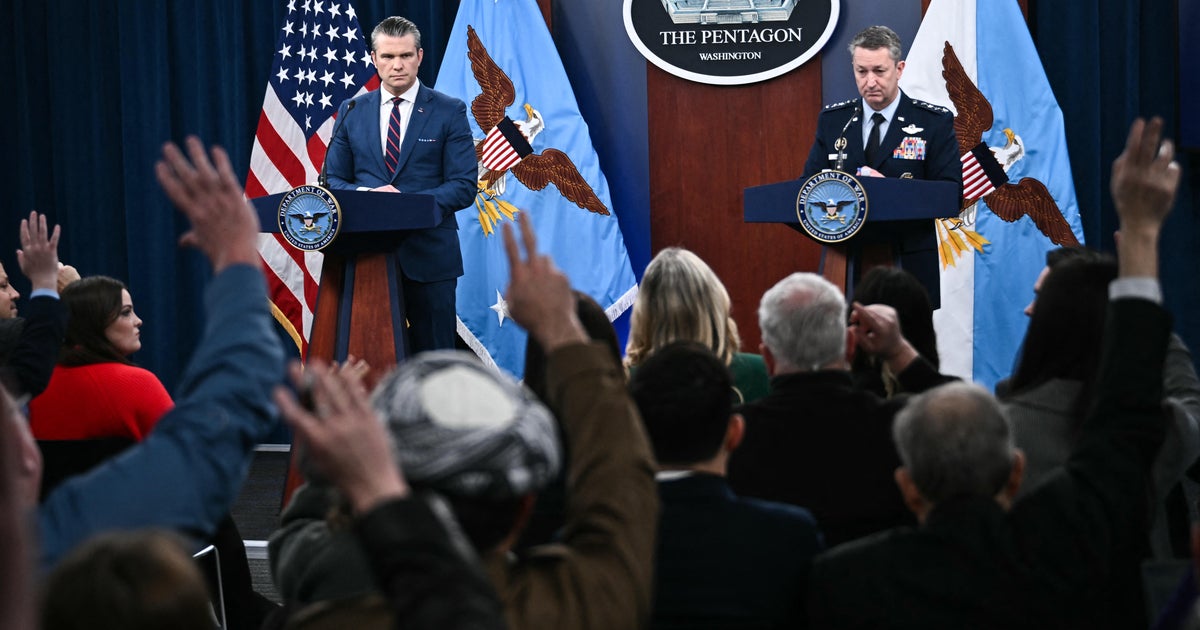
Defense Secretary Pete Hegseth said the deadly strike was caused by a powerful Iranian weapon that made it through both air defenses and the operations center's fortifications.
"You have air defenses, and a lot's coming in, and you hit most of it," Hegseth said during a news conference at the Pentagon. "Every once in a while, you might have one, unfortunately, we call it a squirter, that makes its way through. And in that particular case, it happened to hit a tactical operations center that was fortified, but these are powerful weapons."
But the three U.S. military officials questioned the assertion that the building was adequately fortified. They told TheNews the operations center was a triple-wide trailer made into an office space — a common setup at U.S. bases abroad.
The trailer's only fortifications were T-walls, which are steel-reinforced concrete barriers that can range in height from 6 to 12 feet tall, used to protect military personnel from explosions, rocket attacks and shrapnel, the military officials said.
But T-walls could not protect the facility from an overhead strike. Two officials told TheNews that the strike appeared to hit dead-center on top of the building.
Three officials also told TheNews, speaking under condition of anonymity because they were not authorized to speak to media outlets, that prior to the attack, there were discussions on the ground about whether the tactical operations center in question should not have been used, as it concentrated too many U.S. troops in a location that wasn't defendable.
Preliminary battle damage assessments suggest the operations center in Kuwait was attacked by a one-way drone, according to three U.S. military officials with direct knowledge of Iran's attack. It's not clear what type was involved, but Iran typically uses Shahed-136 "kamikaze" drones.
Fire engulfed the buildings, which made recovery of the bodies difficult in the immediate aftermath of the strike, the officials told TheNews.
Two of the three sources told TheNews they did not recall hearing the warning sirens that are commonly associated with counter-battery systems designed to detect incoming enemy ordnance that ultimately killed the service members. They also said that the warning siren had worked all week prior to the strike on the tactical operations center, but in prior incidents, some of the drones were already inside the base before the siren would sound.
Additionally, two sources said there was no American counter-rocket, artillery and mortar system at Shuaiba port that could be used to bring down incoming drones or other deadly munitions. Kuwait had interceptors in the vicinity, but it's unclear if those were employed.
Requests were made for more capabilities to defeat incoming drones, but those additional resources never came, the two sources said. One source told TheNews: "We basically had no drone defeat capability."
"I'm sorry for their families' losses," one of the sources told TheNews. "They were nice people doing what their nation asked of them."
CNN first on the six service members killed at Shuaiba port and that they seemingly had no prior warning. TheNews is first to report on the type of ordnance that impacted the operations center, and that some American troops feel the center's defenses were inadequate and perhaps that the operations center established should not have been used at all.
Asked for comment, the Pentagon referred TheNews to U.S. Central Command's on the deceased service members.
After this story was published, Pentagon spokesperson Sean Parnell disputed TheNews' reporting, writing in a : "A Tactical Operations Center is not a 'makeshift office space,.' The secure facility was fortified with 6-foot walls." He also said, "Every possible measure has been taken to safeguard our troops — at every level."
In addition to the six who were killed in Kuwait, at least 18 service members had been seriously wounded as of Monday morning in the combat operation, dubbed Operation Epic Fury, a U.S. Central Command spokesperson told TheNews.
Hegseth called the service members who were killed "the absolute best of America."
"May we prosecute the remainder of this operation in a manner that honors them," he said.